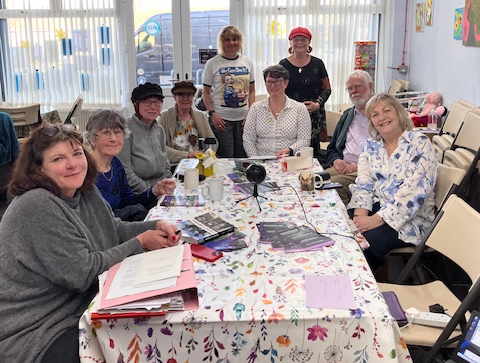
In a world that often forgets, there’s power in remembering. Our ‘Notable Women’ conversation was a tribute to women – brilliant, brave, and frequently erased – whose contributions shaped history but rarely make it into our textbooks. What began as a casual gathering, a conversation among curious minds, evolved into a collective call: to celebrate women who defied the odds, reshaped their fields, and often disappeared into the margins of memory.
The Power of Personal Discovery
Georgia Read-Cutting, a science tutor and writer compiling a book bringing untold stories together, keeps folders filled with inspiring stories of women whose achievements have lifted her through difficult times. They’re not always household names—but perhaps they should be. Like the 24-year-old woman, Antoinette Tuff, who once stopped a school massacre by talking the gunman down. Famous for a moment, then forgotten.
It’s the pattern of disappearance that concerns Georgia the most: “Why do women disappear?” she asked the group. The room grew electric with stories and questions. As participants shared, one thing became clear – many of these women weren’t forgotten for lack of achievement, but because history simply didn’t write them in.
Pioneers in the Shadows
You may know the Wright brothers, but did you know about their equally important sister, Katherine Wright? Or Empress Matilda, who should have been the first Queen of England – disregarded because she was a woman. These names sparked a wave of recollection and revelation.
Others added to the list: Queen Alexandra, beloved and endlessly generous; Mary McLeod Bethune, born to freed slaves, who founded schools and hospitals, and organized the legendary all-Black 6888th Postal Battalion in WWII; and Nancy Wake, a resistance fighter whose heroics led 7,000 men against 22,000 Nazis.
There were scientists like Cecilia Payne, who decoded the composition of stars; Ada Lovelace, the first computer programmer; and Grace Hopper, who pioneered early programming languages. Women like Annie Easley and Mary Wilkes carried that legacy forward in technology, but are rarely credited.
“Wild” Is a Compliment
Take Nancy Wake. Known as the White Mouse, she eluded the Gestapo, parachuted into occupied France, and once killed an SS soldier with her bare hands. She also wore red lipstick well into her 90s. “Wild,” someone called her – and in this group, wild was a badge of honour.
Many of these women weren’t just brave; they were human in complex, often contradictory ways. Marie Stopes revolutionized access to contraception, though her eugenics views make her legacy difficult. Women like her are often erased entirely, while men with similar views remain statues in public squares.
Why Do They Disappear?
Theories flew. Was it because women don’t “blow their own trumpet”? Are we too fragmented, too focused on internal networks to broadcast our power externally? One attendee argued, “We broadcast to ourselves – not the outside world.” Another added, “There’s a real difficulty in getting the handover from older women to younger women.”
Victoria Smith’s Hags was mentioned, tackling how older women are often demonized and sidelined. One chilling example came from the Trump administration, accused of removing women’s stories from federal websites, scrubbing them from collective memory. Yet even that act spurred researchers to seek out and re-highlight these hidden lives.
Stories We Must Pass On
Other names surfaced like sparks: Dr. Lorna Wing, who coined “autistic spectrum”; Beatrice “Tilly” Shilling, who engineered life-saving fixes for WWII aircraft (and has now been celebrated by having a Wetherspoons pub named after her in Hampshire, in tribute to her achievements at Brooklands); Dame Stephanie “Steve” Shirley, who used a male name to found a multimillion-pound software company run by women in the 1960s; Dr. Sue Black, a tech trailblazer and coding advocate for women today, who saved Bletchley Park from ruin and disrepair by starting an online campaign back in 2008, and aviator Sheila Scott, who broke over 100 world records after struggling to pass her flying test.
These are women who pushed through failure, prejudice, and obscurity to make something unforgettable – if only we remember.
This isn’t just about women who’ve vanished from history. It’s also about the women in our lives – mentors, mothers, teachers, neighbours – who inspire us every day. The challenge is not only to find these stories, but to amplify them, to refuse to let them fade.
As Georgia said, “Whenever I’m feeling low, I flip through these stories and think, ‘If she could do that, maybe I can do this.’” We need more of that kind of inspiration in the world.
Thank you to Georgia for leading our intrepid group of explorers into the world of notable women 🙂
 Rochester Literature Festival
Leave a comment